 CodeEraser
How it works
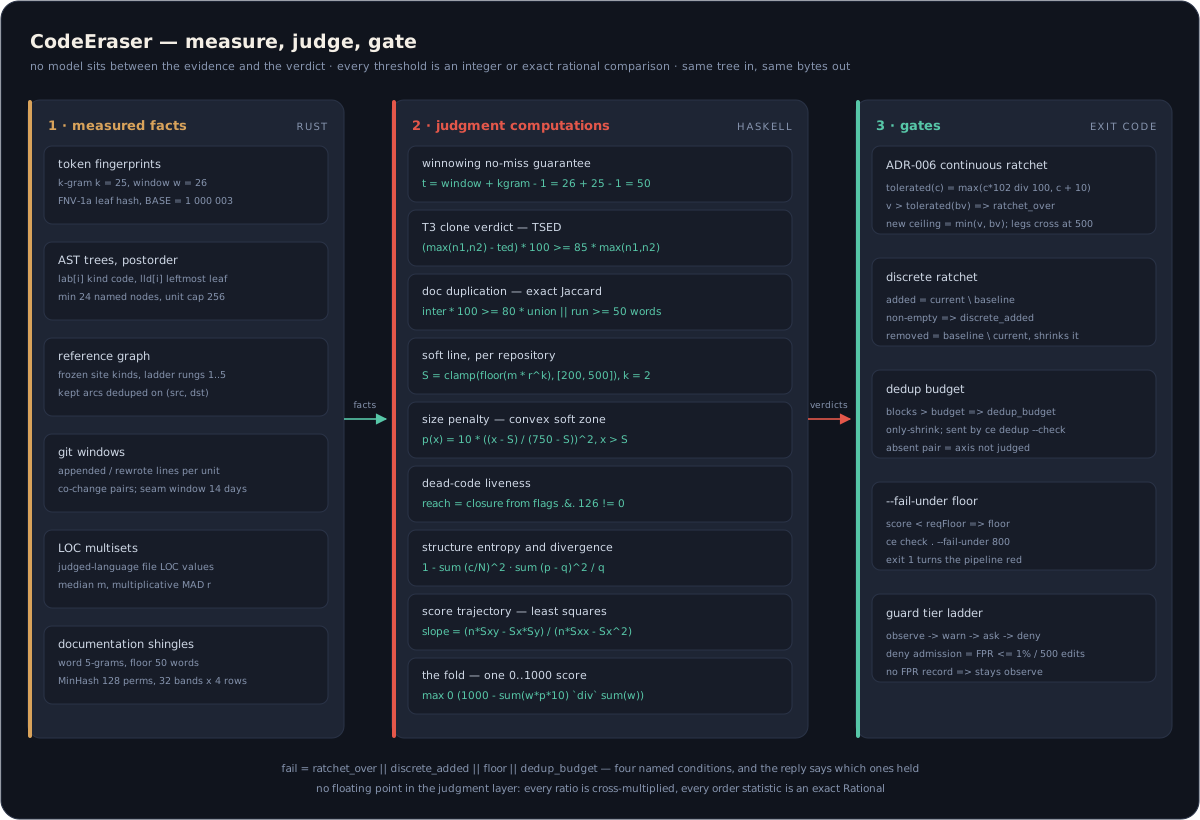
CodeEraser applies deterministic computation to the non-deterministic output of language models.
Why not a second model
A model writing into a long-lived repository stacks rather than
edits: the same function twice, a fact restated in a third file, an update appended. Instead of
auditing that drift with a second model, every verdict below is arithmetic over facts from the tree
(token fingerprints, tree edit distances, graph in-degrees, git-window counts) against thresholds
written down: no sampling temperature, no floating point in the judgment layer, no
model in the loop. The same tree yields the same bytes on any machine at any hour, so a disagreement
is settled by re-running the number and reading the file:line it points at.
Every heading links its full derivation in docs/reference/methodology.md, each constant traced to its implementing line.

The nineteen judgment families
Three counts of “family”
Three counts ship across this site. nineteen booklets, one per judgment whose math earns a derivation: families 01–15 here, 16 on from the analysis track on a page of their own. sixteen judgment capabilities on the wire (the stack diagram's count, beside the handshake hello, the definition package tables/1, the report documents document/1 and six stage capabilities the families call: resolve/1, candidates/1, rank/1, docpairs/1, moves/1, bags/1; the join and the split advisory ride inside verdict and structure requests, and the FPR tier ladder is a discipline, not a request). twenty-one read-only MCP tools follow the report surfaces, not the wire: churn and graph --sites, erase (its dry-run plan only), doctor (machine state), erase_log (the applied-erase trail), update_check (this build against the latest release), similar_units (ce similar's advisory document over similar/1), query and rules over query/1 (its own page), and flow, merge_suggestions and architecture over flow/1, merge/1 and arch/1.
01T1/T2 clone detection — winnowing fingerprint index
Finds exact and parameterized duplicate token runs: renamed variables and changed constants are clones, changed syntax is not.
t = window + kgram - 1 = 26 + 25 - 1 = 50 tokens
Any common run of at least t normalized tokens holds
t - k + 1 = w consecutive k-grams, one complete window, whose minimum depends only on
its contents, so both copies select it: at least one shared fingerprint, always, the Schleimer et al.
SIGMOD'03 no-miss bound held as a correctness contract. The rolling hash is Rabin-Karp,
h = (h - t[i-k]*top)*BASE + t[i], over FNV-1a leaf hashes.
Derivation and constants
- kgram 25
- window 26
- guarantee t 50
- BASE 1_000_003
- hotCap 64
- minDistinct 7
- near-miss band 25 <= len < 50
- TOKENIZER_REV 4
- schema ce.dedup-report/0.5.0
02T3 near-miss clones — tree edit distance (TSED)
Judges units whose ASTs are almost the same but whose token streams are not: reshaped and rewritten copies.
TSED(a, b) = (max(n1, n2) - ted(a, b)) / max(n1, n2)
clone      ⇔ TSED >= 0.85
cloneDecidesWith (num, den) t n1 n2 = (mx - t) * den >= num * mx where mx = max n1 n2
ted is Zhang-Shasha with unit costs (delete = insert = 1,
relabel = 0 on matching kind codes, else 1), always integral, so the comparison is an exact
cross-multiplication decidable both ways: at max = 100, ted 15 is a clone
and ted 16 is not. Two O(1) prefilters, q · tsedDen < tsedNum · max for
q ∈ {min(n1,n2), I} with I = Σ_label min(c1, c2), cut pairs before any TED
runs; they are admissible because they use the same 85/100.
Derivation and constants
Since 1.8.0 verified pairs ride ce check's clone axis and
ce join's similarity leg as sim kind 1, each verdict cached under the two trees' content
keys until the proto or a knob changes.
- tsedNum 85
- tsedDen 100
- minUnitNodes 24
- unitNodeCap 256
- pairCap 4096
- lshShape (128, 32, 4)
- hotCap 64
- schema ce.clone-report/0.3.0
03Documentation duplication — shingling + MinHash/LSH
Decides whether two documentation blocks (markdown paragraphs, HTML text, plain-text paragraphs, comment blocks, docstrings) are near-duplicates.
dupDecidesWith num den inter union  =  inter * den >= num * union

dupVerdictWith (num, den, vfloor) inter union run
  =  dupDecidesWith num den inter union  ||  run >= vfloor
Bound to (80, 100, 50): Jaccard ≥ 0.80 decided in integers,
or a verbatim run of at least 50 words. The core computes inter and
union itself from the ascending deduped shingle sets, so raw counts cross the wire, never
a ratio. MinHash/LSH is an RNG-free coarse filter (the permutation index is the salt); a run of
R shingles spans R + k - 1 words.
Derivation and constants
- jaccardNum 80
- jaccardDen 100
- shingleK 5
- minDocTokens 50
- verbatimFloor 50
- docLineCap 200
- licHeadLines 5
- docSetCap 8192
- docPairCap 4096
- DOCDUP_REV 8
04Structure judgment — tree-scale entropy, eight axes
Judges the tree rather than the file: directory geometry, naming distributions, reference locality, documentation coverage, doc staleness, redundancy, modularity.
tsallis2 cs     = 1 - Σ (c/N)^2            -- and = 0 when N == 0
tsallis2Norm cs = tsallis2 cs / (1 - 1/n)  -- n = nonzero bins, n > 1
chi2 pairs      = Σ_{r > 0} (p - q)^2 / q  -- p = o/Σo, q = r/Σr
perMille r      = floor (r * 1000)
charge_i = floor(scale * v_i / (v_i + N))   -- v = flagged dirs, N = dir total
raw      = Σ_axes (charge_i * violCost)
score    = max 0 (scale - raw `div` (structViolCostNeutral * judgedAxisCount))
Shannon entropy and KL divergence need logarithms, not exactly decidable,
so the family uses their rational-closed relatives, Tsallis-2 diversity and the χ² f-divergence, over Data.Ratio. Observed mass on a zero-reference bin makes χ²
Nothing, a refusal that names those directories. An axis's mass v is its
flagged-directory count, charged into ‰ of scale and folded through
structViolCostNeutral = 10; judgedAxisCount is 5 to 8, by which optional
fact tables rode the wire.
Derivation and constants
- violCost 10
- scale 1000
- depthCeil 8
- fanoutCeil 30
- namingMin 5
- namingCeil 600‰
- mixRefFloor 5
- misplaceMin 3
- bigDirFloor 8
- staleMin 1
- dupMin 1
- deadMin 1
- structNodeCap 524288
- modFloor 1
- modMassFloor 4
05Scoring and the ADR-006 ratchet
Folds seven axes into one 0–1000 score and gates it against a banked baseline that may only tighten.
raw     = sum_i (w_i * p_i * violCost)
wTotal  = sum_i w_i                            -- derived, never a literal
score   = max 0 (scoreScale - raw `div` (violCostNeutral * wTotal))
p(x) = 0                              if x <= S          -- S read as min S H
     = pMax                           if H <= S          -- degenerate fallback
     = pMax * ((x - S) / (H - S))^2   if S < x <= H
     = pMax * (1 + 2*(x - H)/(H - S)) if x > H           -- C¹ linear arm

m = gmedian(x)                                 -- log-space median: √(x_lo·x_hi) when the count is even
r = gmedian( max(x/m, m/x) )                   -- >= 1 by construction
S = clamp(floor(m * r^k), [softMin, min softMax H])
tolerated(c) = max (c * tolNum `div` tolDen) (c + tolAbs)   -- tolAbsCoc on a complexity row

added   = current \ baseline        -- non-empty => fail
removed = baseline \ current        -- informational; drives the shrink
Axis 0, the only one that is not a count, is a convex penalty on file size
in exact Rational, monotone past the hard line; pMax is the value
at H, not a ceiling. The soft line S is the repository's own frozen
LOC statistic, S = clamp(median + k·MAD, …) rewritten multiplicatively so no logarithm is
taken, derived at establish and frozen into the baseline. The fail bit is a disjunction of
six named conditions, ratchet_over,
discrete_added, floor, dedup_budget,
knobs_digest, rows_dropped, printed after FAIL in that order.
Derivation and constants
Since proto 3.1.0 a continuous row may carry its path class, the
1-based index of the first matching [[rules.class]] (0 for none), and is
charged against that class's soft line, hard line and CoC ceiling, the global line as fallback.
Beside the ceilings' codes 0 / 1 / 2, classKnobs adds 3
(proto 5.1.0), the class's ratchet allowance in lines, and 4 (proto 6.4.0), its
cognitive-complexity allowance; declared, either replaces both global legs, so
0 means any growth is over. The baseline stays three columns; names and globs never
cross the wire.
- scoreScale 1000
- violCost 10
- defaultWeight 1
- sizeHard H 750
- sizePMax 10
- softLineK 2
- [softMin, softMax] [200, 500]
- sizeCeil fallback 300
- cocCeil 15
- deadIndegCeil 0
- rewriteNum/Den 50/100
- sccFloor 2
- tolNum/tolDen 102/100
- tolAbs 10
- tolAbsCoc 1
- legs cross at 500
- verdictNodeCap 131072
- verdictRowCap 524288
06Graph liveness and dead-code verdicts
Answers "which files does nothing live reach?" over a reference graph whose node identity is the row index, with no text on the wire.
arcs  = { (s,d) | [s,d,kind,rung] ∈ edges,  rung <= minRung,  kind ∉ inert }
reach = ⋃ { reachable(G, s) | s ∈ entries(entryMask, flags) }
public     = testBit flags 0
referenced = indeg >= 1 over kept arcs
judged     = i ∉ reach
code       = 1 + public + 2*referenced    -- the lookup table is the authority
Four codes keep an
exported-but-unreferenced API from collapsing into plain dead: 1 unref_private,
2 unref_public, 3 unreach_private, 4 unreach_public. A site walks
its language's rungs in order and the first rung yielding exactly one in-scope candidate
wins; more is Unresolved, and External is a correct answer, not a miss.
Cycles are reported, never judged; a cyclic island with no entry seed is dead by reachability alone.
Derivation and constants
inert = {3 asset, 5 unused ref-def}, excluded by the core:
an image link renders bytes and an unused reference definition renders nothing. Since proto 2.32.0
each dead row carries a confidence judged from the per-language site ledger (0 unvouched, 1 vacuous,
2 vouched), the erase family's trust boundary. Import-edge precision: 38/40 = 0.95
over five pinned corpora against a ≥ 0.90 gate, on a sample frozen before any resolver existed. The six
languages plan v2.30 added each passed a frozen, blind-audited exam: C 73/73, C++ 15/15, Java 36/36,
Lua 86/86, R 18/18, HTML 75/75 (recall 73/74, 15/17, 36/36, 86/86, 18/18, 75/76), and a per-language
false-positive ledger (six corpora, 400 commits each) shows 0 false intercepts; see
EVAL-SET-LANGS and
FPR-REPLAY.
- minRung 5
- entryMask 126 (bits 1–6)
- sccFloor 2
- nodeCap 131072
- edgeCap 524288
- GRAPH_REV 23
- tsconfig extends unbounded, cycle-checked
- precision gate ≥ 0.90
07The three-signal join
Combines similarity × graph position × churn into one of four candidate codes, then deliberately declines to act on it.
(1, sev 2, [1,2,3,4], [])    -- merge_candidate:  sim + graph + both referenced + distinct SCCs
(2, sev 3, [1,2,5],   [6])   -- delete_candidate: sim + graph + dead flank, RG10 guard clear
(3, sev 1, [1,2,7,8], [])    -- churn_hotspot:    sim + graph + cochange + rewrite
rewriteHot  = total > 0 && (rewrote_a + rewrote_b) * rewriteDen >= total * rewriteNum
cochangeHot = cochange >= cochangeFloor
legsMask    = legSim .|. (if graphBoth then legGraph else 0) .|. legChurn
Priority is data, not guard order: the first row whose required bits hold and forbidden bits stay clear wins, else code 0, so the property battery can falsify the order by rotating the table. Every gating row requires the graph bit: mask 5 (graph leg absent) carries only code 0 rather than pretending indegree 0.
Derivation and constants
Since proto 2.33.0 each candidate row carries a leg-agreement
confidence, the severity face ships once as joinSeverity, and
ce join judges over the same verdict/1 road as the check gate. No join code enters the
fail bit: ce join exits 0 unless the run fails, and a missing or refusing core is a run
failure (exit 2).
- rewriteNum/Den 50/100
- cochangeFloor 2
- entryMask 126
- legSim 1
- legGraph 2
- legChurn 4
- cochangeFileCap 20
- schema ce.join-report/0.4.0
08Split-ROI seam pricing (four legs)
Prices "is this long file worth splitting, and where?" as a number, an advisory outside the structure score and the fail bit.
benefitMilli(u) = max 0 (floor (1000 * (p(total) - p(end_u) - p(total - end_u))))

costMilli(u)    = crossRefs(u)      * roiRefMilli
                + cutClones(end_u)  * roiCloneMilli
                + crossChurn(u)     * roiChurnMilli
                + roiPhiMilli

viable          ⇔ b >= c            -- ROI >= 1, evaluated without division
Benefit is the graded-zone penalty a split returns, on the same
convex curve the verdict family uses (imported, not re-derived); p is convex with
p(0) = 0, hence superadditive, so the bracket is non-negative. The best seam is the exact
rational argmax over ROI, compared by cross-multiplied b % c; n top-level
units give n - 1 seams. Long-and-cohesive gets an exemption with numbers
attached, long-and-splittable a cut line.
Derivation and constants
- seamSoft S 300
- seamHard H 750
- seamPMax 10
- roiRefMilli 250
- roiCloneMilli 500
- roiChurnMilli 150
- roiPhiMilli 500
- NAME_FLOOR 3
- CHURN_WINDOW_DAYS 14
- knob codes 12–18
09Edit four-classification (update supervision)
Reduces every supervised edit to four integer counts per file pair (matched, novel, moved, deleted), so "stacked, not applied" becomes a measurement.
siteOpens s n  =  n * movedCost + s  <  n * plainCost

destFloor      =  least n with siteOpens siteCostCross n   =  2
accepted   = isStart && distinctEvidence >= destFloor && anchored
anchored   = any (\(_,_,w) -> w >= anchorFloor) evidence
The cross-file evidence floor is derived: siteCostCross = 2
makes a single cross line a tie (1*1 + 2 = 3 = 1*3), ties do not open, so
destFloor is 2, and that tie is the coincidence rejection. Only
anchorFloor = 19 is decided: in the dual-corpus shadow ablation the invented station's
widest anchor measured 16 alnum characters and the thinnest real anchor 19, so 19 tops the window
that kills every measured coincidence and keeps every real site. The L2 delta moves one way:
plain lines may become moved, never the reverse.
Derivation and constants
Since proto 7.1.0 paired declRem / declAdd
tables of declaration keys that vanish on one side and appear on exactly one other open an edge when
the spans share declFloor = 1 leftover hash (the key pays
declCredit = siteCostCross). They append relocations with lines = 0; no line
class, block, suspicion or score moves.
- movedCost 1
- plainCost 3
- siteCostWithin 0
- siteCostCross 2
- destFloor 2
- anchorFloor 19
- MAX_D 3000
- maxBridge 7
- bucketCap 64
- stackingNovelFloor 20
- stackingRatio 10
10Score trajectory — the trend slope verdict
Is the check score going up, flat or down across history, and by how much per day?
x_i   = ts_i % 86400                 -- seconds to days, exact ratio
y_i   = (score_i * 1000000) % scale_i

slope = median{ (y_j - y_i) / (x_j - x_i) : x_i ≠ x_j }   -- Theil-Sen
slope < -band  → 2  (degrading)
slope >  band  → 0  (improving)
otherwise      → 1  (flat)        where band = floorMicro
% is Data.Ratio's exact-ratio constructor, not
modulo; y puts every commit on a fixed 10⁶ full-scale grid, so rows under different
scoreScale values compare. The slope is the median of pairwise slopes (trend/2): one wild
point drags a least-squares mean anywhere and cannot move the median past its neighbors.
Derivation and constants
The judged view sorts by timestamp and keeps the tsWindow most recent
points, so rebased commits are legal. The steepest single-step fall ships as cliff, the
longest strictly-falling run as declineRun, each by request index; hashes never cross.
Below minPoints, or with no timestamp-distinct pair, the slope is Nothing,
never a fabricated flat; at the default floor 0, degrading is reported and cannot fail.
- minPoints 3 (knob 0)
- declineFloorMicro 0 (knob 1)
- row + knob cap 4096
- tsWindow 512
- full-scale grid 10⁶
- schema ce.trend-report/0.3.0
The FPR discipline: what earns a rule the right to deny
11FPR discipline and the guard tier ladder
A deterministic gate over a non-deterministic writer: on
PreToolUse for Write|Edit the guard answers each pending write with exact
arithmetic, and a rule class enforces only once it has paid for the right.
TIERS = ["observe", "warn", "ask", "deny"]
PROMOTED_DEFAULT = "deny"
cap      = lines_for(file).file_lines_fail     // the file's class table; 750 for class 0
breach   ⇔ cap != 0 && lines > cap

permille = (lines - S) * 1000 / (H - S)
0   ..= 249  →  observe
250 ..= 750  →  warn
751 ..       →  ask
Derivation and constants
| tier | permissionDecision | effect |
|---|---|---|
| observe | none, returns before printing | feed line only, no injected text |
| warn | allow | edit proceeds, reason surfaces as a visible warning |
| ask | ask | the user is prompted |
| deny | deny | write is refused, reason points at the existing file:line |
Determinism comes from replaying the write:
resulting_lines computes the exact post-write line count, and a call that would fail on
its own (missing file, ambiguous non-replace_all match) returns None, so the
rule stays silent. An unrecognized [guard] mode resolves to
observe (ce.toml ERROR: …), never passed through.
A class earns deny by its record. M3:
≤ 1 mis-block in 500 real normal edits, N=1 demonstrations disallowed.
M4: FPR ≤ 1% over 500 real normal edits on a set pre-registered before
implementation, ≥ 200 edit samples, ≥ 50% from real agent transcripts, sampled only from observe-mode
and pre-guard sessions so the guard cannot certify itself. Two classes have paid: T1/T2 exact duplicate
write, and hard-budget breach at file > its hard line (750 by default, or the file's
[[rules.class]] line), so the hook denies exactly where the CI wall fails.
Every other rule stays at observe for want of its own record.
Since CodeEraser 1.2.0 the duplicate-write rule charges novel
duplication only: the K-round replay of 2,761 real edit events (this repository's history plus the
pinned requests tail) separated genuine landings from re-fires on already-budgeted files
and split/fold mid-states, so matches the replaced content already carried (Write: the
on-disk file; Edit: old_string) are subtracted. A rewrite carrying its debt is silent; an
introduction, or a split to a new file, denies and teaches the ordering that passes (trim the source
first). Both framings: FPR-REPLAY.md.
Replaying linear git history as an edit stream at the shipped knobs
t = 50 and min_distinct = 7: 630 events, 35 blocks, 0 false after
arbitration → 0.00 per 500 (M3), the 35 blocks remediated as the clone-block budget stepped
251 → 211 → 209 → 205 → 202. The standing instrument (cli/tests/it/fpr_replay.rs,
2026-09-05): requests 365 events / 0 intercepts; 3164 self-repo events with 178 landed introductions
and 79 write-first mid-states.
The graded zone reads S and H off the hard
budget's per-file table. [guard] zone_tiers is off by default: its
pre-registered rule armed only if every corpus read ≤ 1 %, and the first run read self
0.54 % but requests 2.46 % (variant B), held by cli/tests/it/fpr_zone_gate.rs. Warns are
rate-limited to once per (rule, file, session) and clipped at a token budget; a deny is not.
- file_lines_warn S 300
- file_lines_fail H 750
- zone_tiers false
- FPR gate ≤ 1% / 500 edits
- WARN_BUDGET_TOKENS 200
- STOP_BUDGET_TOKENS 400
- CHARS_PER_TOKEN 4
- feed schema ce.observe/0.13.0
Acting on the verdicts: erasure and advice
12Deterministic erase — the safety predicate
Judges erase-plan rows for three provable
classes (dead_file, verbatim_doc, t1_twin) and refuses every
unsafe row with a named reason code.
class  = 0 (retired 4.0.0, refused by name) | 1 verbatim_doc | 2 t1_twin
         3 dead_file (confidence road, 2.32.0)
reason = 0 eraseable | 1 language_unresolved | 2 not_full_segment
         3 bytes_differ | 4 copy_not_dead | 5 unit_not_covered
         6 public_surface (6.1.0)
Rust assembles integer facts from the three source families; Haskell applies a fixed first-failure predicate. Since proto 2.32.0 class 3 trusts the graph family's per-row confidence; since proto 6.1.0 a public dead verdict (2 unref_public, 4 unreach_public) is refused as public_surface before confidence is weighed, so an exported API is never eraseable; only then does an unvouched confidence refuse the row.
Derivation and constants
Class 0, the local-count road, retired at proto 4.0.0; the core refuses it by name. A degraded over-cap reply authorizes nothing, and the safety surface has no knobs.
- classes 4
- reason codes 7
- eraseRowCap 4096
- since proto 2.16.0
- wire erase/1
13Unmentioned-declaration advisory — the mention veto
Lists every judged declaration whose name no other file spells, with a visibility code: a negative instrument that never judges.
veto  = another file spells it | fold (Rust, ≥2 segments ∧ ≥7 chars)
        | the file's own exception regions spell it
row   = [node, vis, conv]      (integers only — a name never rides the wire)
emit  ⇔ vis ⊇ {exported, scope-exported} ∧ conv has no exempt bit (0..10)
code  = 1 private > 2 restricted > 3 reexported > 0 public
Derivation and constants
U is its own walk: hidden files enter, .git/.ce
are cut by name, an undeclared nested repository is cut whole, and a path the root's
.gitmodules declares stays as foreign (it can spell a name, never measured). Only
.gitignore and .ceignore are honoured, so one commit yields one U, and every
walk parameter is a MENTION_REV input; the store keeps 64-bit hashes, never text. Haskell reads only the visibility word and the mounts row
(private mod mounts, façade re-export, package-private). Both tables ride
graph.request together or not at all; without them the reply is the ten-key one byte for
byte and the dead set is unchanged. Past unmentionedCap the core drops the table and says so. Never a gate, never in
ce erase.
- MENTION_REV 4
- FOLD_MIN_CHARS 7
- unmentionedVisMask 3
- unmentionedCap 131072
- unmentionedHardCap 524288
- since proto 6.2.0
- wire graph/1
The change-time family: what an erasure leaves behind
The families above read a tree; the fourteenth reads a change
(one edit, session or commit) at the PreToolUse hook, the Stop audit and
ce precommit / ce commitmsg.
14Tombstone residue — the erased-name conjunction
Catches the change that erases X from the code and writes it back as an absence:
a heading (no X), an identifier without_x, a sentence
X is no longer needed.
R     = ⋃ names(before) \ ⋃ alive(after)      (structural positions only; keys, never text)
row   = [kind, marks, names]                  kind ∈ {0 bracketed, 1 bare, 2 prose}
site  ⇔ names ≥ 1 ∧ (kind ≠ 2 ∨ marks ≥ 1)    (the conjunction, read per sentence)
over  ⇔ budget declared ∧ |sites| > budget     (spoken at [tombstone] tier; ships observe)
Derivation and constants
A name is what a text declares: an identifier outside comments and
literals, a unit name, a heading, a list lead; an inline code span only mentions, keeping a name alive. Rust sends three
integers per added surface; Haskell seats the sites and judges the budget. A changelog-role document is exempt whole, by path convention,
ledger shape or [tombstone] ledger; a quote run or section that is itself a ledger exempts
only itself. The class ships at observe; promotion would argue from the nine-round FPR
replay over two histories in docs/FPR-TOMBSTONE.md.
- TOMBSTONE_REV 1
- min_ascii_name 3
- min_wide_name 2
- join_max 3
- SEGMENT_TOKENS 3
- minName 1
- minMarks 1
- tombstoneRowCap 65536
- HASH_CAP 256
- SITE_CAP 10
- since proto 6.6.0
- wire tombstone/1
The advisor family: the units that play the same part
Clone families need two units to look alike; the fifteenth finds units that
play the same part with no line in common, as advice at
ce similar, the MCP tool similar_units, the GUI's similar screen
and one line of the Stop audit.
15Same-role advisor — sparse retrieval and in-repo association
Ranks the units most like one unit (or a text) by integer BM25 over six-channel term bags from the index's facts, and asks the core which play the query's role: an offline "code RAG", no model, no float, advisory only.
bag    = six channels N P C D S L        (facts the parse already carries; hashes, never words)
score  = Σ w · idf · 22·tf·avg / (10·tf·avg + 3·avg + 9·len)   (k1 = 6/5, b = 3/4; integer fixed point)
widen  = top-m PPMI neighbours at ≤ ½ weight    (opt-in view; never evidence)
role   ⇔ (N ≥ 1 ∧ C ≥ 1) ∨ (N ≥ 2 ∧ shapeEqual)  (judged in Haskell over similar/1; advisory only)
Derivation and constants
Each T3-universe unit gets one bag (name pieces, shape, callee spellings,
its doc segment, node-kind histogram, literal kinds), every word stemmed and hashed with its
channel letter. Bags persist in the content-hash-gated refresh (bag is its own posting
list; a pair table measured 7–10× the cold index and was not built, so co-occurrence is derived at
query time). The in-memory instruments and the SQL reader feed one trait-written request and send the same
bytes on every unit of five corpora. Rust sends the query bag, the df and postings of the terms that
score and the seats' lengths; Haskell weights, widens, scores and cuts the top K over
rank/1, then orders exact rationals and applies the role conjunction over
similar/1. Floors from two arbitrated
oracle generations: 60 % on the first sample, 40 % on the holdout, which retired every tuning
candidate the first sample favoured. Never a gate, never in
ce erase.
- SIMILAR_REV 1
- K 5
- wUnit 256
- TERM_CAP 96
- topM 3
- minCooc 2
- roleMinName 1
- roleMinCallee 1
- roleMinNameShape 2
- similarCap 65536
- since proto 6.7.0
- wire similar/1
Three honesty boundaries
PreToolUse shapes behavior; it is not a security
boundary: Bash: echo >> or sed -i bypasses it, and the backstops are
the Stop audit over git diff (write-tool agnostic) and the CI gate. The hook is
deliberately fail-open: an internal failure allows the edit and lands in the observe feed
instead of reading as "no duplicates". Both are written into the plan: a gate that lies about its reach is
worse than one that states it.
One request line to the core is at most 134,217,728 bytes (maxLineBytes,
the limits.caps.line_bytes the core states), and the reply reader stops at twice that. A family
whose request would pass the line splits it into batches; an item that alone would pass it is refused by
name, never truncated, so a verdict is never judged on part of its input.